
Prairie Mountain Health (PMH) held its 2024-2025 Annual General Meeting (AGM) on Wednesday, October 22..
Board chair Lon Cullen and Chief Executive Officer Treena Slate, along with other members of the PMH Executive Management Team reviewed the previous operational year (April 1-2024-March 31, 2025) with a focus on our services, strategies, priorities and planning.
The AGM provided another opportunity to acknowledge and recognize the tremendous efforts of health care staff, physicians and volunteers who continue to assist individuals and families who need care and support within the region.
View our annual report
The detailed 2024/2025 PMH Annual Report and audited financial statements are available on our website here.
Prairie Mountain Health holds Annual General Meeting
Prairie Mountain Health (PMH) wrapped up its 12th full year of operations during its Annual General Meeting (AGM) October 30, 2024. PMH Board Chair Lon Cullen said reviewing fiscal year 2023-2024 allowed interested community representatives, health stakeholders and partners, staff and residents to learn more about the region’s strategic priorities, objectives and financial position.
“Communication with our partners and stakeholders regarding health care within our communities and region as a whole is a top priority,” Cullen stated. The AGM is another way we are able to provide a status report on PMH activities and an opportunity to keep residents and communities engaged at the same time.” recap
Prairie Mountain Health CEO Treena Slate says the AGM also provides the opportunity to reflect back on accomplishments, acknowledge the challenges and opportunities for improvement that lie ahead, and move forward with a focus on future program and service planning.
“We’re making great strides in several areas as our recent Accreditation Report notes although we know there is much more work to do,” Slate said. “We acknowledge and sincerely appreciate the commitment of our staff—our most valuable resource. They continue to give of themselves with unwavering dedication, care and compassion. To our staff, thank you for all that you do!”
This past year saw the region undergo its third national accreditation survey, which found PMH met 97 per cent of surveyed criteria. Other AGM highlights noted were:
The Region focused on it’s Strategic Plan (2023-2028) that identified the health region’s four key priorities aimed at building a healthier population and creating a quality, integrated and sustainable health system through collaboration and informed-decision-making.
Patient and family engagement, along with patient-centered care, remained key objectives for PMH.
Several key capital projects were in varying stages, including construction on the new Neepawa Health Centre, clinical spaces renovations at Brandon and Dauphin Regional Health Centres and Western Manitoba Cancer Centre.
A building addition for a new cancer care unit in Russell and enhanced space for a new CT Scanner in Swan River were finalized in the spring of 2024. Both of the projects received significant financial contributions from local communities.
Emergency Department renovations in Virden, Killarney and Souris were completed. These refreshed treatment spaces now provide dedicated space for registration and triage, greater privacy, wayfinding and better sight lines for staff.
Various recruitment and retention strategies for physicians, nurses and other health care-professionals remained a priority area and several activities to sustain, enhance and develop capacity within the workforce continued. The region has seen some recent recruitment success including new specialist and nurse practitioner hires.
The region continues making strides on improving mental health and addictions services. Enhancements to in-house treatment services, support and treatment programs and community mental health improvements were continuing throughout the year.
PMH’s Mobile Clinic passed a significant milestone in February, marking 10 years since the first primary care bus in the Province began providing access to services where some care barriers remain. Currently, the Indigenous communities of Birdtail Sioux First Nation, Ebb and Flow First Nation, O-Chi-Chak-Ko-Sipi First Nation and Keeseekoowenin First Nation receive regular visits. The communities of Canupawakpa Dakota First Nation, Skownan First Nation, Sioux Valley First Nation, Tootinaowaziibeeng First Nation and Waterhen also receive regular Nurse Practitioner services from Mobile Clinic providers.
PMH experienced an operating deficit in 2023/24 of $29.7 million after having balanced its operating budget the previous year. This was largely related to the increase in salary expenses related to the use of agency and overtime to maintain current service levels. A financial accountability working group has been established to look at fiscal sustainability initiatives and cost savings opportunities going forward.
Join us on Saturday, October 5 for the Westman Yoga Festival, a day filled with relaxation, mindfulness, and rejuvenation. Get ready to dive into the world of yoga and connect with like-minded individuals. Lunch will be provided. Held at the Keystone Centre from 9am to 4pm. For all abilities ages 18 plus. Cost is $52.50. Register here. Registration deadline is September 27.
7th Street Health Access Centre Celebrates 20 Years
June 17, 2004 – 20 years ago, 7th Street Health Access Centre officially opened its doors, offering medical care and social service support to anyone in the downtown area of Brandon, with a specific focus on anyone living with persistent and severe mental health issues, newcomers to Canada, and under-served seniors.
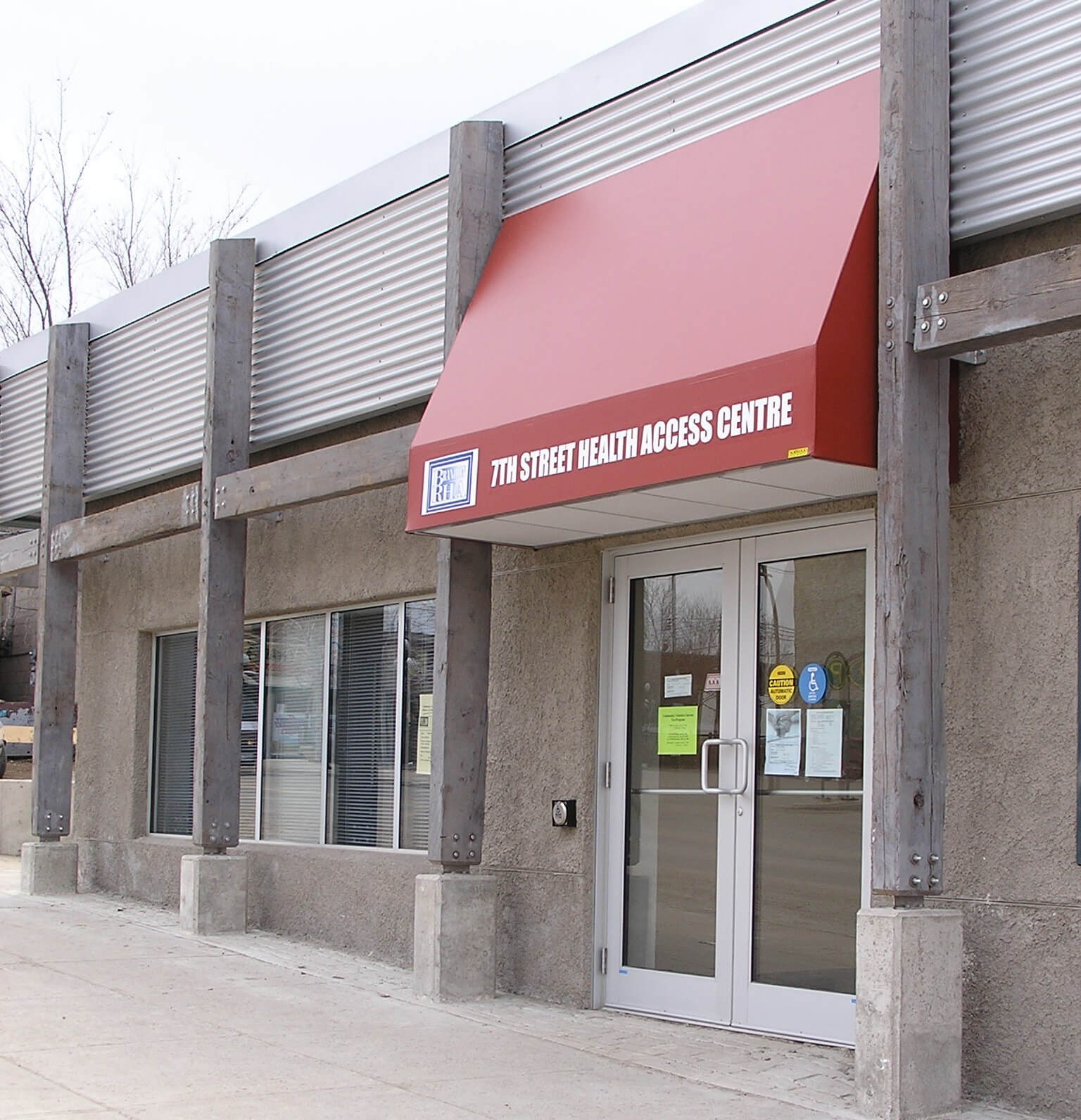
Services available within the Centre at that time included medical care from a family doctor or advanced practice nurse; child and family services staff; public health staff offering travel health; healthy baby and STI/HIV/Hep C services; addictions counsellors; mental health counsellor; and service navigation to connect to services and programs in the building or the community or elsewhere in the health care services. Reception staff were also core services helping people access the free amenity services such as public use of telephone and computers, shower and laundry services, photocopying or faxing, or scheduling appointments. Community Volunteer Income tax provided free tax filing for those on limited income. On weekends, it had a core staff of a service navigator, reception and a housing resource worker, which was a slim staff for a large building.
Although many of these services existed elsewhere in the community of Brandon at the time, bringing them all together in one building and making services available during evenings and weekends was seen as innovative and unique at the time. Located downtown, 7th Street Health Access Centre aimed to offer timely services with a motto of “right provider, right time, right place,” and for those needing multiple services, the aim was to reduce the number of times the client “had to tell their story” with each staff they worked with.
Over the next 20 years, services evolved, client volume increased, hours changed, staff changed, services were added, and core services with weekend staffing remained. Fast forward to June 17, 2024, and 7th Street Health Access Centre is bursting with staff and services. Hours of operation have changed from noon to 8 pm, to 11 am to 7 pm for many years, to 10 am -6 pm for a couple of years to today’s hours of 9 am to 5 pm, still seven days a week. Except for Child and Family Services and the public health services of Healthy Baby and Travel Health, the initial services we started with remain. Added services include: Community Nurse; Cultural Facilitators to respond to the language and cultural needs of our newcomer population; Dietitian; Homecare Wound Care staff; HIV Clinic; Hep C treatment; Rapid Access to Addictions Medicine (RAAM) clinic; Financial Facilitator; EIA partner staff; Community Social Workers; Outreach worker; harm reduction initiatives and itinerant support groups over the years. Amenity services such as laundry and shower facilities, public use of phones and computers, photocopying, and faxing have steadily increased in usage seven days a week.
7th Street Health Access Centre aims to be responsive to the needs in the community, especially the most vulnerable or least resourced and adjusts services and staff accordingly to address the ever-growing or changing needs. Staff also partner with many other agencies and services within Brandon and around the province to meet the needs of those we work with and offer services to. When one first learns of all that is available at 7th Street Health Access Centre, it has often been commented that 7th Street Health Access Centre is “the hidden gem.” Although we have been around and growing and serving for 20 years, many still do not know what services and supports are available at 7th Street Health Access Centre, and many do not realize we are a part of Prairie Mountain Health.
Welcome to our “20 years of service” celebration on June 17, 2024. Come and see for yourself what our Centre has to offer.
For more information or to find out how to connect with a service provider, please call 204 578-4800.

Prairie Mountain Health held its Annual General Meeting November 1st
Prairie Mountain Health (PMH) held its 2022-2023 Annual General Meeting (AGM) on Wednesday, November 1st. The AGM was hosted by Chief Executive Officer Brian Schoonbaert and Board of Directors Chairperson Lon Cullen. Board Finance Committee Chairperson Shep Kaastra and PMH Regional Lead Corporate Services and CFO Dan McGregor also participated to deliver the 2022/23 finance report.
PMH staff, community representatives, organizational members and area residents joined the online interactive meeting held via Zoom.
Schoonbaert recapped strategies and actions related to recruitment, capital planning, and other organizational priorities related to the last operational year (April 1, 2022-March 31, 2023). He also took the opportunity to recognize, acknowledge and appreciate the tremendous efforts of health care staff, physicians and volunteers who have and continue to provide care.
The meeting ended with a question period for attendees to ask their own questions on PMH’s current operations, challenges and initiatives underway within the region.
The detailed 2022/2023 PMH Annual Report and audited financial statements are available on the PMH website here.
Watch the full recording of the annual general meeting:
Watch the 2022/23 Year Recap Video
This video was played during the annual general meeting and is included in the full meeting recording above.
With the arrival of June 21 comes the summer solstice, the longest day of the year.
Annually, June 21 is National Indigenous Peoples’ Day (NIPD).
Indigenous people acknowledge the teachings of the four seasons by their representation on the medicine wheel. Summer is a time of growth and warmth. NIPD provides the experience to grow in awareness and understanding and build relationships as people come together to celebrate the culture of Indigenous people.
Prairie Mountain Health (PMH) acknowledges the history, heritage, traditions and experiences of First Nations, Inuit and Métis peoples within our health region.
Prairie Mountain Health provides health services on the original lands of Treaty 2 & 4, territories of the Dakota, Ojibway and Cree people and the Red River Métis. We acknowledge the traditional territories and treaties that confirm recognition and respect for the Indigenous populations – past and present.
PMH encourages all who deliver health services on the original lands of First Nations people and on the homeland of Métis citizens to recognize the ongoing obligation to provide culturally safe care. As an organization, we will continue to embrace the distinct cultural knowledge, practices and traditions of Indigenous Peoples and continue efforts to strengthen relationships with the Indigenous communities and peoples who we serve.
The Brandon National Indigenous Peoples’ Day Committee will host an in-person event at Riverbank Discovery Centre on Wednesday, June 21, 2023, from 12:00 to 8:00 pm. The outdoor event will include a tipi village, cultural displays, Indigenous entertainment, powwow demonstrations, children’s activities, a bannock demonstration, a food tent, and more. All of which will highlight the unique value of Indigenous culture and ways of knowing. The Brandon Urban Aboriginal Peoples’ Council will hold a tipi raising at the Riverbank Discovery Centre on Tuesday, June 20th starting at 10:30am, in preparation for the events on June 21.
National Indigenous People’s Day Events around PMH – Brandon
If you are holding events in the PMH region, please share information by emailing the details to [email protected]
For NIPD events near your area, contact your local First Nation or Métis community.
For more information on NIPD, check out the Government of Canada’s link
Prairie Mountain Health (PMH) is preparing to hold its 2020/2021 Annual General Meeting (AGM) on Wednesday, October 13th from 12 pm (noon) until 1 pm. Chief Executive Officer Brian Schoonbaert invites PMH staff, community representatives, organizational members and area residents to participate in the online interactive meeting.
“Besides a review of our audited financial statements, we will have the opportunity to look back over our operational year (April 1-2020 – March 31, 2021), with a focus on our planning, care strategies and implementation of services related to COVID-19. We’ll briefly touch on our current fiscal year, which is now over 6 months complete, and provide an opportunity for participants to ask or send questions,” Schoonbaert stated.
Join our virtual meeting online or by phone
The annual general meeting will be held via Zoom which offers attendance by both online and phone.
On May 28, 2021, the day after 215 children’s unmarked graves were discovered on the grounds of a former Indian Residential school near Kamloops B.C., the House of Commons passed a bill to establish a statutory holiday called the National Day of Truth and Reconciliation. The passing of the bill fulfills one of the many recommendations made by the Truth and Reconciliation Commission report to honour survivors, their families, their communities, and to ensure that public commemoration of the history and legacy of Indian Residential schools remains a vital component of the reconciliation process.
The significance of this day will be to remember the victims, survivors of Canada’s Indian Residential School System. In Canada’s efforts to forge a new country, one of its goals was to absorb the First Nations into the general population and to extinguish their culture. In 1878, the new government under the administration of John A. McDonald commissioned a report to look at residential schools in the United States. That report lay the foundation to say that only residential schools could separate Aboriginal children from their parents, culture and cause them “to be merged and lost” within the nation. The report said that the government “should work with the Christian churches to open these schools.” Thus began the Indian Residential School system here in Canada in 1883. The government of Canada made school attendance compulsory in 1894 and empowered the Royal Canadian Mounted Police to seize children from reserves and bring them to the residential schools. Years later, government officials known as Indian Agents continued to carry out the role of gathering children to attend the schools.
Origin of Orange Shirt Day
Phyllis Webstad was only 6 years old when she was sent to St Joseph’s Mission Indian Residential school in British Columbia. Her grandmother had taken her to the store and bought her a brand new orange shirt to wear to school. Phyllis was proud of her new orange shirt but when she arrived, she was stripped of her clothing and never saw her orange shirt again. She was neglected, abused, and made to feel like she did not matter. Phyllis recalled that every child cried to go home, but nobody cared. Fortunately, Phyllis was able to return home to her grandmother. As she became an adult, she said that the colour Orange reminded her of that time in her life. She later used her story as a platform to raise awareness to Orange Shirt Day and “That Every Child Matters.” Phyllis’ story is a difficult one to hear, but has helped to raise awareness to the legacy of Canada’s Indian Residential school system and the impacts to survivors like Phyllis and their families. Read her full story here.
Wear an Orange Shirt on Thursday, September 30, 2021 – the National Day for Truth and Reconciliation.
October 3-9 is Mental Illness Awareness Week in Canada. It is a time to promote awareness of mental health issues in general, reduce the stigma around mental illness, and shed light on those who unfortunately still tend to suffer in silence and isolation. Mental illness does not discriminate. It affects people of all ages, education, income levels, and cultures.
The Elderly and Depression
One of the segments of the population where mental illness is often overlooked is among the elderly. The rates of those diagnosed with depression in older adults aged 65 and over are about the same as the national average for the general population. However, the rate of those in this age group experiencing general symptoms of depression(not diagnosed) is significantly higher. About 15% of older persons report symptoms of depression (Canadian Psychological Association).
Many of the elderly across our nation live alone and are significantly isolated from family and society. The Covid-19 pandemic has only further intensified that isolation. Older adults are not connected socially in ways that younger generations tend to be. The effects of loneliness and isolation worsen anxiety and depression and make it more difficult for them to reach out and find the support they need.
We need to be sensitive to the needs of the elderly in our community, whatever their living situation. Keeping connected with our older loved ones will allow us to understand their mental health needs better and help them find the services they may benefit from and get the help they need.
As part of Mental Illness Awareness Week, on Oct. 7, the Canadian Mental Health Association (CMHA) Swan Valley Branch is offering a free 1-hour online presentation on Mental Health Experiences and Older Adults. Take advantage of this resource to learn more about the mental health challenges that many older adults experience and learn practical ways to promote good mental health and well-being among the elderly. More information and an online registration form can be found at: https://parkland.cmha.ca/events/older-adults/
For mental health services available in Prairie Mountain Health, visit our website.