
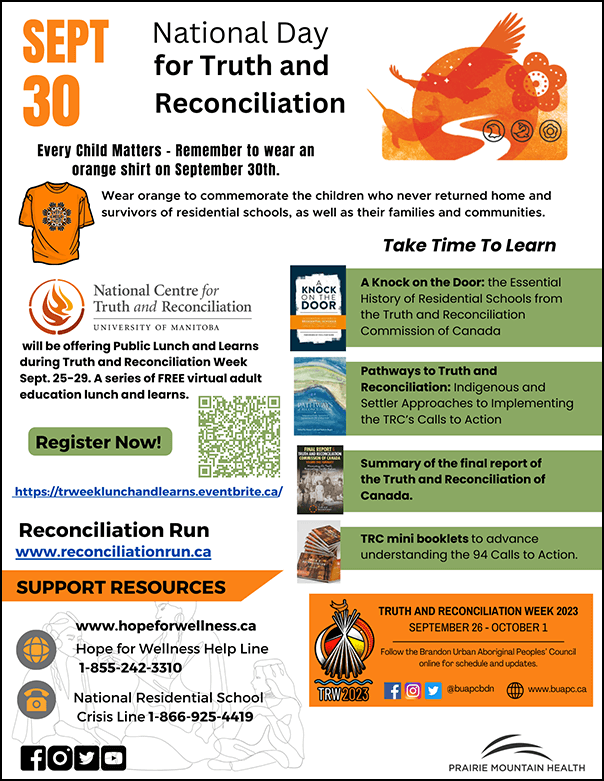
National Day for Truth and Reconciliation | September 30
Prairie Mountain Health is located on the original lands of Anishinaabeg, Cree, Oji-Cree, and Dakota peoples and the homeland of the Métis Nation.
Prairie Mountain Health has committed to begin the work of reconciliation with the Indigenous people and communities in our region.
Many generations of First Nations, Métis and Inuit children were forcibly placed in more than 130 residential schools in a calculated effort to eradicate Indigenous languages and cultures from the 1870s to 1996.
On the northwest side of Brandon was the Brandon Residential School, which operated from 1895 to 1972. The legacy of the residential school era continues today and impacts us all.
In June 2021, the Government of Canada passed Bill C-5 to name September 30 the National Day for Truth and Reconciliation to recognize the past harms and wrongs inflicted on Indigenous children in residential schools by making it a federal statutory holiday.
September 30, also known as Orange Shirt Day, acknowledges Phyllis Webstad’s story that started the movement.
To commemorate the children who never returned home, survivors of residential schools, and those impacted by this legacy, WEAR ORANGE to show your commitment to reconciliation.
Take a moment to reflect on what reconciliation means to you and how you can advance reconciliation in the workplace and in your community.
Reconciliation is inevitable, though it is how we choose to make the relationship with Indigenous people that matters.
Nellie Kopitz – Regional Manager of Indigenous Health, Prairie Mountain Health
Events Throughout Our Region
This is a small list of many events happening within within our region. We encourage you to participate in events in your community. If you are an event organizer, please email [email protected] to have your event added to this list.
- Birdtail Sioux Dakota Nation – The 2023 Reconciliation Run will take place on September 30th. The run will start at 8:00am at the ruins of the original former Birtle Residential School, and conclude on Birdtail Sioux Dakota Nation. Once all participants have made it back to Birdtail Sioux Dakota Nation, community members, volunteers, and participants are invited to a community gathering/feast. Learn more.
- Brandon Urban Aboriginal Peoples’ Council – Tuesday, September 26 to Sunday, October 1. All events will take place on the grounds of the Riverbank Discovery Centre in Brandon, except the flag raising ceremony will be held Tuesday morning at City Hall. Visit the BUAPC Facebook page to stay up to date and see the full schedule.
- Dauphin – September 30, 220 Whitmore Ave (Parkland Crossing) at 11:00 am. Please join us as we take time on this day to commemorate the tragic and painful history as well as the ongoing impacts of residential schools. Cultural entertainment will follow.
- Swan River – Join in on September 30th for the National Day for Truth and Reconciliation walk. Beginning at 11am, Elbert Chartrand Friendship Centre (1413 Main Street E) Free lunch to follow.
Links
National Day for Truth and Reconciliation – Government of Canada.ca