
Emergency Department

Mental Health is Everyone’s Story

Mental Health is Everyone’s Story

 “Today is where your book begins / The rest is still unwritten” – Natasha Bedingfield

Since 1951, The Canadian Mental Health Association has hosted Mental Health Week, which takes place annually during the first week in May. In 2023, Mental Health Week will take place from May 1st until the 7th, and the theme this year is “My Story.” The choice of My Story highlights the reality that we all have a mental health story that we can share, which evolves. This story is shaped by many forces, notably the emotional and practical support that we receive in our lives, which guides us, protects us, and elevates us, along with our resilience and coping tools and the resources and programs we utilize in our communities. Learn more about Mental Health Week here.

The emotional benefits of storytelling and journal writing are well documented in the scientific literature. The act of writing something out makes it more tangible; what existed as internal and hidden can be expressed, seen, heard, and with that, perhaps easier to manage or put away, if needed. We can organize our thoughts, and review our story, reflecting on our resourcefulness and fortitude. There is also the importance of sharing one’s journey with others. A story can be told in many ways, through a speech, conversation, written story, poem, painting, video, or song, to name a few. It is not just the act of telling or writing but knowing that what you share will be read or viewed by others and the hope that someone else might be inspired or helped by your story. For those on the receiving end, listening to others’ stories can also be validated in that we may be experiencing similar concerns, overcoming similar obstacles, and perhaps have similar circumstances. By witnessing someone else’s story, we also learn from their wisdom and experience. Sharing one’s mental health story is one of the most effective ways to reduce stigma (other or self) toward people who experience mental health issues. It may also remind those going through challenging times that there is light and hope.

In her research on the benefits of sharing one’s story, Dr. Sherry Hambe, Clinical Psychologist and Director of the Life Paths Research Program at the University of the South, offers the following points:     

  1. Realizing that sharing your story can help others. This can be especially powerful for people who do not always feel that they have the chance to support others on their journeys.
  2. Finding your voice. Expressing yourself and thinking about what has happened in your life in a way that makes sense. It helps to think about how the various events—even the distressing ones—have been part of a journey toward the person you want to become.
  3. Re-affirming your values and priorities. The act of expression can be a way to clarify what is important.
  4. Finding peace, finding hope. People who have shared their stories often find a sense of peace, well-being, and freedom and a way to let go of elements that hindered them, such as anger or guilt.

Despite the many benefits of storytelling, it is important to remember that your story is shared in a manner, a platform, and an audience that is safe and trustworthy. Also, share your story from your viewpoint and that you are talking about yourself. Please refrain from talking about others unless you have their permission, and even then, keep it about you.   It is also best to think about your boundaries before telling your story. There may be aspects of your story that you wish to keep private. You do not have to tell all of your stories or answer questions you do not want to answer. Finally, telling your story may be an emotional experience, and it is important to have support to lean on during and after the storytelling process.

For more information on how to tell one’s mental health story, visit the “Sharing Your Personal Story- Speaker’s Toolkit”.

Although beneficial, telling your story does not replace seeking help. If you or someone you know is experiencing mental health concerns, the following services are available in the Prairie Mountain Health Region:

 CRISIS – SOUTH DISTRICT (formerly Brandon, Assiniboine)

  • Adult crisis line, 24/7:  1-888-379-7699
  • Youth Under 18 crisis line 24/7:  1-866-403-5459
  • Crisis Stabilization Unit:  1-855-222-6011 or 204-727-2555
  • Mobile Crisis Services: 204-725-4411

CRISIS – NORTH DISTRICT (former Parkland)

  • Adult and Youth Crisis Line, (24/7):  1-866-332-3030

NON-CRISIS – SOUTH

  • Adult Community Mental Health Intake: 1-855-222-6011 (M-F 8:30-4:30)
  • Youth (17 and under) Community Mental Health Intake, see resources here.

NON-CRISIS – NORTH

  • Mental Health Intake (all ages)
    • Roblin:  204-937-2151
    • Ste. Rose du Lac:  204-447-4080
    • Swan River:  204-734-6601
    • Dauphin:  204-638-2118

Learn more about accessing Mental Health Services here.
Mobile Addictions Clinic Pilot Project

Mobile Addictions Clinic Pilot Project Underway in PMH

March 15, 2023

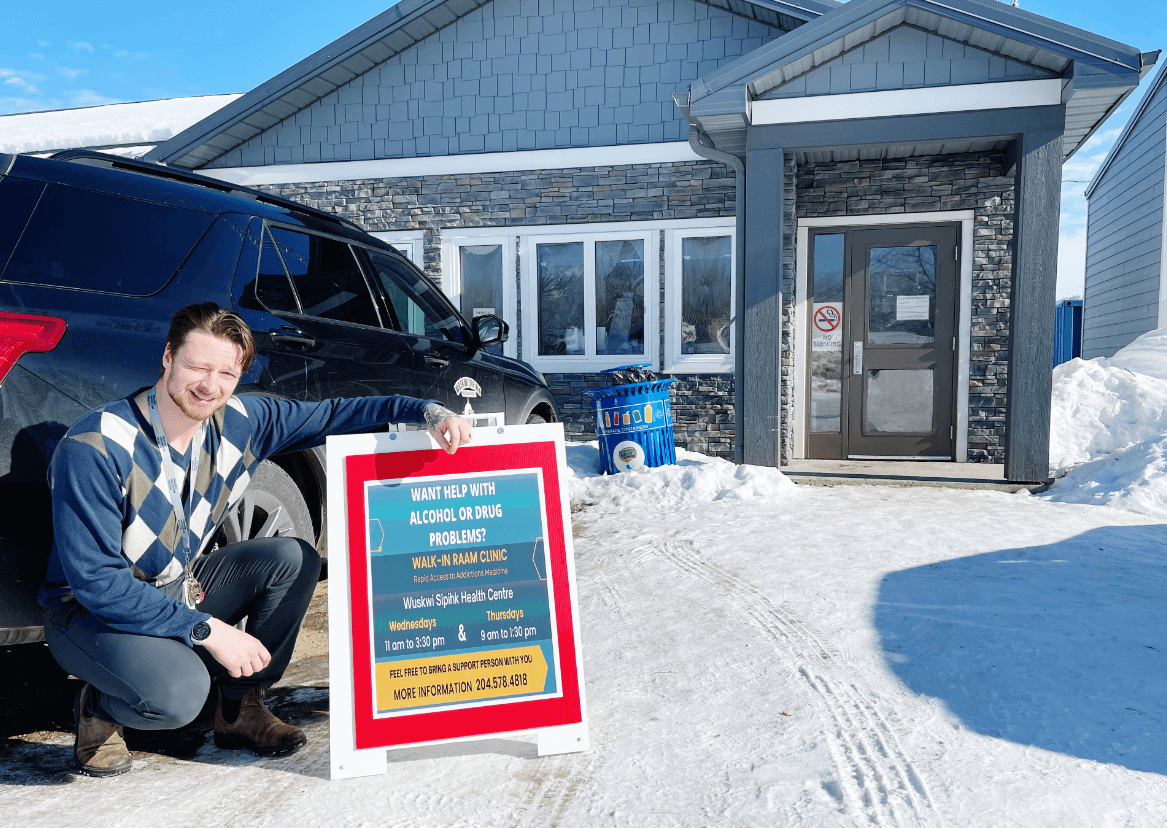
In partnership with Health Canada and Shared Health, Prairie Mountain Health has commenced a pilot project to further enhance access to addictions services within the health region. With the support of $897,416 from Health Canada’s Substance Use and Addictions Program (SUAP), and in collaboration with local health partners and stakeholders, PMH is offering mobile Rapid Access to Addiction Medicine (RAAM) clinic days in three communities: Wuskwi Siphik (weekly) and Russell and Virden (bi-weekly).

The Mobile RAAM Clinic is a crucial step in addressing addiction, the stigma surrounding substance use disorders, and trying to eliminate barriers to access services and support. I am privileged to be a part of this program, and allow for change within Indigenous communities burdened by this epidemic. – Colton Roback, Nursing staff, Mobile RAAM Clinic – Wuskwi Sipihk First Nation

Mobile RAAM Clinics feature a staffing complement consisting of a physician, nursing staff, rehabilitation counsellors, and administration support. On clinic days, nursing staff and rehabilitation counsellors, with experience in harm reduction, will travel to the local health care clinic to provide services. A physician will be present (in-person or by virtual means) on the first day of each clinic in each community.

The team clinic approach supports ‘in-community’ services and builds capacity for local primary health-care providers to manage ongoing treatment of all substance use disorders, including the use of Opioid Agonist Therapy (OAT).

The mobile clinic project is an extension of the RAAM model, first introduced to Manitoba in 2018. Service delivery is based on improving access to addiction medicine through low barrier walk-in clinics. People can visit to get help for substance use without an appointment or formal referral. There are currently six site-based clinics located in Manitoba, including one in Brandon at the 7th Street Health Access Centre.

To view the RAAM Clinic schedules within Prairie Mountain Health, visit the PMH website here.

Making a Difference in our Communities

I feel the Mobile RAAM Clinic pilot project in our community is truly a blessing!
With the assistance of PMH and the clinic staff we can help our community members to survive and possibly live a longer life. The mentoring that is being provided to our Nurse Practitioner will give her the ability to assist our members in the areas of harm reduction. She will also be able to manage ongoing treatment of the substance disorders for our clients. We are very grateful for this opportunity to help our community members in need. The PMH staff, doctors and nurses are very friendly and wonderful to work with. The community members are very grateful to have this health project in our own community.

Cynthia Munro – Health Director, Wuskwi Sipihk First Nation

As the physician on the ground for the project, I’m very glad to have the institutional backing to provide care directly to populations most affected by the stark economic realities of travelling for healthcare in rural Manitoba. I’m excited by the connections we’re forming with health-care providers in very small communities, which are increasing their ability and confidence to care for challenging and complicated patients. If we’re lucky and committed, we can create a robust integrated network of addictions care throughout the region appropriate for our geography and social circumstances.

Dr. James Rae, Mobile RAAM Clinic Physician, PMH

As someone who has worked in addictions for over eight years, I am most enjoying the medical support of the Mobile RAAM team. The mobile RAAM clinic offers an opportunity for people to reach out and receive support when they need it. There is no waiting weeks for appointments in order to start the process and people come in when ‘they’ are ready to explore or begin the process of change.
Having the opportunity to speak with a counsellor, nurse, and physician in one location on the same day helps to manage the significant transportation barriers we see in our rural communities.

Christine Little, Rehabilitation Counsellor, Mobile RAAM Clinic – Virden, Russell

Being able to reach people a little closer to home who aren’t able to get themselves to a larger center like Brandon on a regular basis due to distance. I’ve enjoyed being able to see this service expand into rural communities where services like this are nearly non-existent.

Lynsey Jensen, Nursing Staff, Mobile RAAM Clinic – Virden, Russell

In working collectively with the Mobile RAAM team, we’ve had the ability to harness our own unique knowledge and strengths, while providing a service that is fluid and supports the autonomy of each individual we work with. I continue to learn so much from my team, and am so grateful for the support I receive from each of them. We have also had the opportunities to collaborate with different agencies, which has supported our ability to increase substance use treatment education in the community, enhance service opportunities, and build opportunities to overcome barriers and bridge gaps in services for those accessing substance use treatment and care. In bridging gaps and building connections with our clients as we support them holistically in making positive, we ensure no one is lost within the gaps, providing greater access to increased levels of success for each individual. In a short time, I have already witnessed the positive changes our program has provided and look forward to the months to come as we continue to expand our program to an exceptional capacity!

Sesley Sloboda, Rehabilitation Counsellor, Mobile RAAM Clinic – Wuskwi Sipihk First Nation